A couple of weeks ago, I saw the news that ECAM (owned by GardaWorld) just bought Pro-Vigil from their previous PE overlords, Riverside Capital. A couple of years ago, they had bought Stealth Monitoring, which makes them by far the largest remote guarding provider in the US - possibly the world.
Interesting enough, this acquisition didn’t have a big press release - it was one low key linkedin announcement on the Pro-Vigil LinkedIn page:
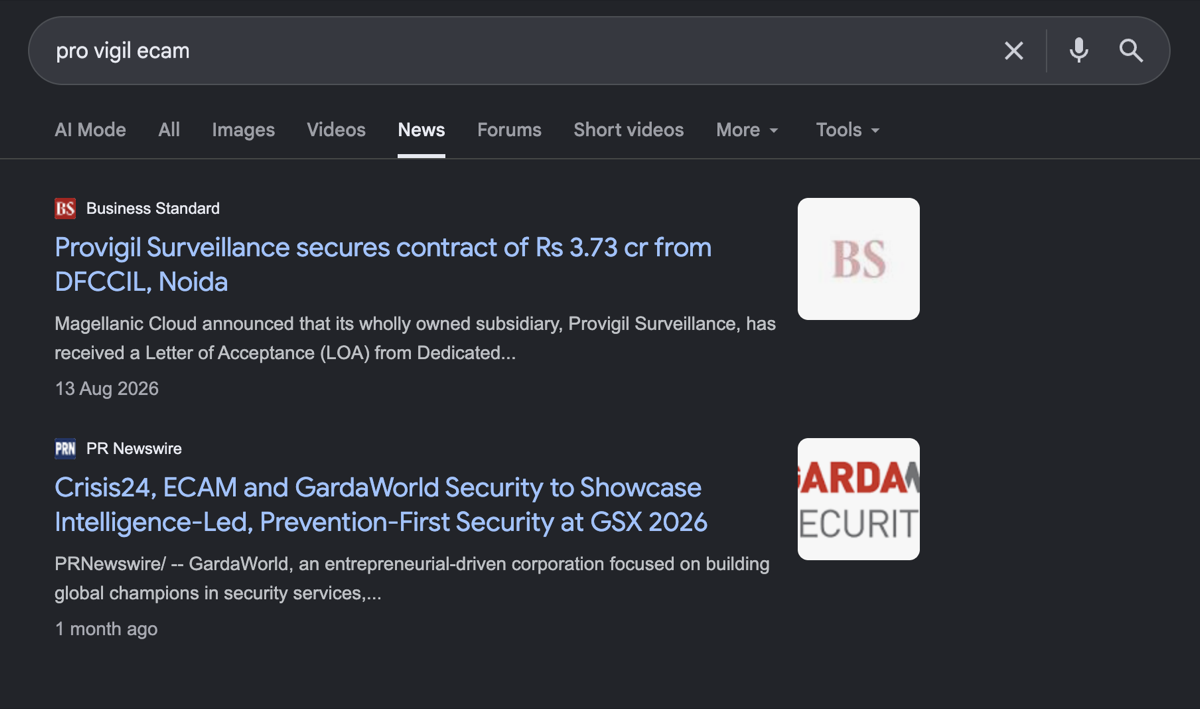
Above: no news - they didn’t even bother with a press release
Below: only a low key LinkedIn announcement
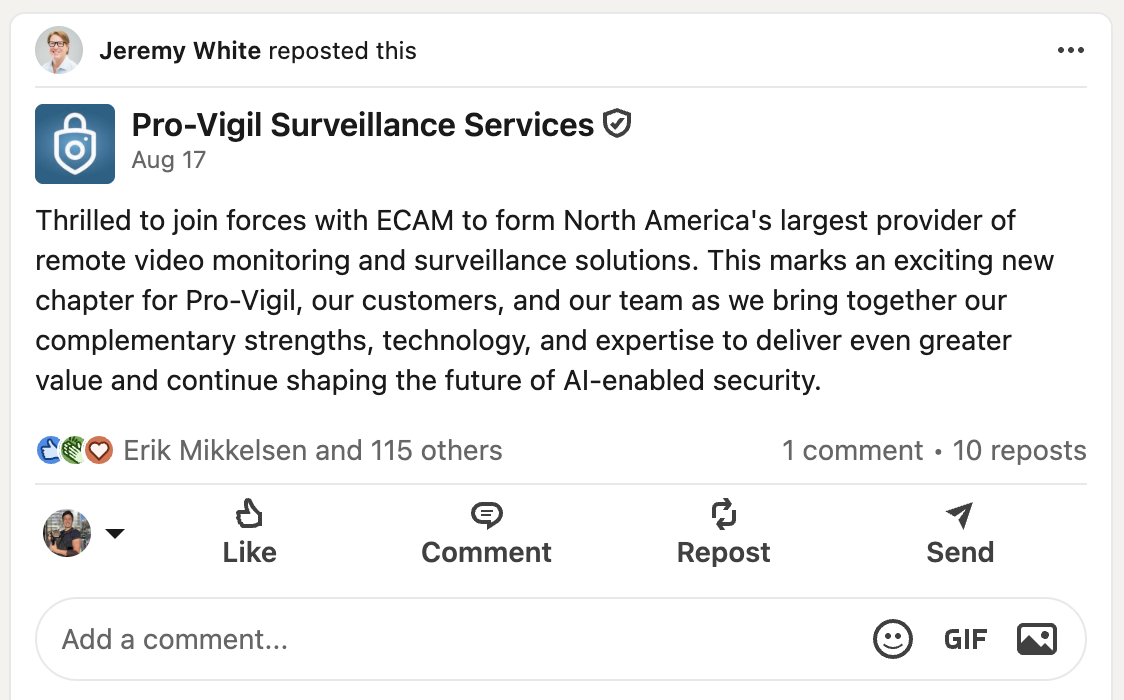
It is highly unusual for a company that was monitoring 30,000-40,000 cameras (thus probably around ~$40M-$50M ARR) to have no fanfare at all when acquired, even if it was an acquisition that didn’t make a lot of money for the previous owner.
This tells me that Pro-Vigil was likely struggling with growth, churn, and maybe even unit economics at the time of its purchase, and it was probably some kind of firesale situation.
Why would a monitoring operation of that size quietly sell itself off to a competitor? It comes down to the way that video monitoring operations are structurally broken.
The way video monitoring works today:
- A camera triggers motion
- Motion clip is sent to a lightweight object detection model that filters for human activity
- A short clip (often just 1-3 frames) is sent to an alarm management platform such as Immix or Sentinel
- Operator reviews and decides whether to take further action
There are multiple issues here with this workflow:
- “Human activity” could be damn near anything - especially since these models are far from perfect, and often pick up environmental debris as false alarms, thus cluttering the alarm queue
- Getting 1-3 frames (notorious issue especially with SMTP triggered events) means that the object detection model will miss stuff, and also makes it really hard for monitoring operators to make a decision.
The way that some companies have tried to address this issue is that they would set the object detection model to be super sensitive, then just throw bodies at the problem - often from ultra low-cost countries.
Pro Vigil does most of its monitoring in India; Stealth Monitoring does most of its monitoring in the Philippines. It’s not a secret that both companies employ this model, and now both companies are owned by the same parent company - the manned guarding conglomerate, GardaWorld.
The problem is that this model doesn’t really work.
“Bombard your operators with nuisance alarms, then have your developing country sweatshop play cleanup” doesn’t exactly inspire confidence from your customers, and likely leads to heightened rates of customer churn and reputational damage that even the most aggressive go-to-market team can’t offset.
Other players in the industry also have this problem, perhaps to a slightly lesser degree.
They’ll use a higher quality 3rd party model which are very likely far better than whatever the hell Stealth and Pro-Vigil built in-house and also have in-house US / Canada based teams doing the bulk of the event triage - but the problem is the same:
Even a high quality object detection model will bombard your alarm queue because there’s no way for it to tell the difference between a catalytic converter thief and an employee staying late.
A packed alarm queue means missed detections - because the only thing operators can do is either bulk dismiss and gamble there was nothing there, or work through the queue chronologically and respond to a real threat far too late.
This was an unsolvable problem until about 12 months ago.
Now AI agents can watch your cameras and even take follow-on action, but it’s also not a panacea - if you use the wrong model, you’ll have worse performance than incumbents; if you use the right model but aren’t carefully engineering your video ingest pipeline, you could end up upside down in your unit economics…well because tokens aren’t free either.
There’s a reason why VCs are betting on the whole concept of “AI-native services” - of which Verdun is one. They’re betting that by combining agentic automation with high quality human judgement, there are a lot of very painful and difficult real-life workflows that could be solved.
We’re making the same bet - that we can finally solve video monitoring and provide a really high quality service at affordable scale; something that no incumbent has been able to solve yet.
Written by Sonny Tai, completely manually with no AI input.